Training Is Not Learning
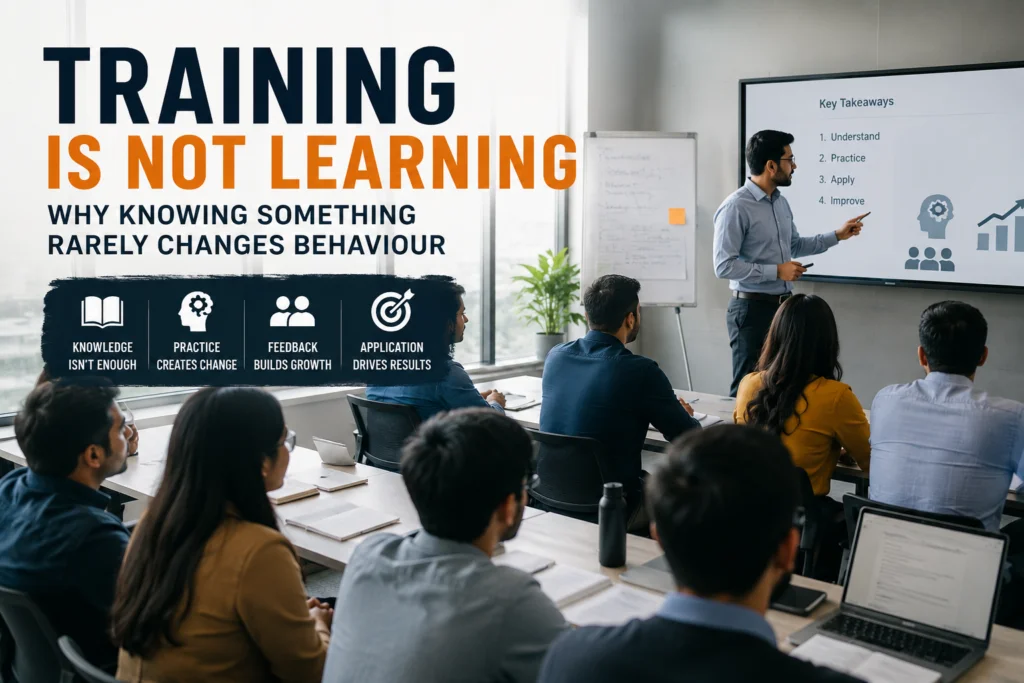
Why Does Knowing Something Rarely Change Behaviour?
Real learning begins when knowledge moves beyond the training room and starts changing how people think, act, and perform. A training session ends. The feedback is positive; participants enjoyed the session, and perhaps everyone even passed the assessment. A week later, people return to work and very little changes. This raises an important question:
Did we deliver training, or did we actually create learning?
Knowing Is Not the Same as Doing
Training can provide information, introduce a new skill, explain a process, or show people a better way of working. But knowing what to do does not automatically change what we actually do. A manager may understand the importance of active listening, for example, but under pressure still interrupt, give quick answers, and fall back into familiar habits. The knowledge is there. The behaviour hasn’t changed. And that is where the real challenge of learning begins.
Beyond Training Completion
We often measure learning through attendance, training hours, completion rates, assessments, and participant feedback. These measures are useful, but they tell us primarily whether training happened, not whether learning translated into the workplace. Perhaps we should move beyond asking: “Did they complete the training?” and start asking:
“What are they doing differently because of it?”
That small shift changes our focus from training activity to learning impact.

Managers Are Part of the Learning Process
Capability building cannot belong to HR or L&D alone. Managers play an important role in helping learning move from the classroom into everyday work. Sometimes this requires nothing complicated. A manager can simply ask: What did you learn? What will you do differently? Where can you apply it? What support do you need?
And Sometimes, Training Isn’t the Answer
Not every performance problem is a training problem. Before prescribing another programme, we should ask what is actually preventing the desired behaviour. Is it a lack of knowledge? A skill gap? Unclear expectations? Poor processes? Lack of resources? Conflicting priorities? Or an environment that reinforces the opposite behaviour? If someone already knows what to do, giving them more information may not change anything. That is why effective learning begins with understanding the problem, not simply scheduling the training.
Perhaps the better question for L&D is not: “What training should we deliver?” but:
“What capability are we trying to build?”
Training is an event; learning is a process. Development becomes meaningful when what people learn begins to influence how they think, communicate, decide, lead, and act. Training delivers information. Learning creates understanding.
“What do you think creates the biggest gap between training and actual behaviour change in the workplace? Share your perspective below; I’d be interested to hear what you’ve observed in practice.